Flock printing services create a premium, velvet-like texture on fabric and other substrates using short fibers (“flock”) bonded into adhesive. Compared with standard ink printing, flock printing delivers a raised, soft-touch finish with strong visual depth—making it popular in apparel logos, fashion branding, home textiles, and specialty labels. This guide explains what the flocking process is, how electrostatic flocking works, what makes flock printing durable, and how real factories control quality at every step—covering fiber length control, moisture and conductivity management, sieving classification, and lab testing such as “flight time” to predict uniform flock deposition.
Introduction to Flock Printing Services (What You’re Buying)
-What are Flock Printing Services?
-What makes flock printing different from standard printing?
What is the flocking process?
-Overview of the complete flock printing workflow (high-level map)
-Key inputs that determine final quality
How does electrostatic flocking work?
-Electrostatic Flocking (core concept)
-Electrostatic flocking vs non-electrostatic flocking
-China electrostatic flocking machine: what buyers should verify
Is flock printing durable? (Durability, Wear, Washing)
-Is flock printing durable?
-Durability factors (what improves lifespan)
Quality Control at Every Step (Based on Real Factory Practice)
-Incoming material standards (fibers, adhesive, base fabric)
-In-process QC checkpoints (example workflow)
-Lab test matrix (turn QC into a simple table)
Applications: What Are Flock Printing Used For?
-What flock printing is used for (best-fit use cases)
-Flock printing on fabric: fabric suitability guide
Introduction to Flock Printing Services (What You’re Buying)
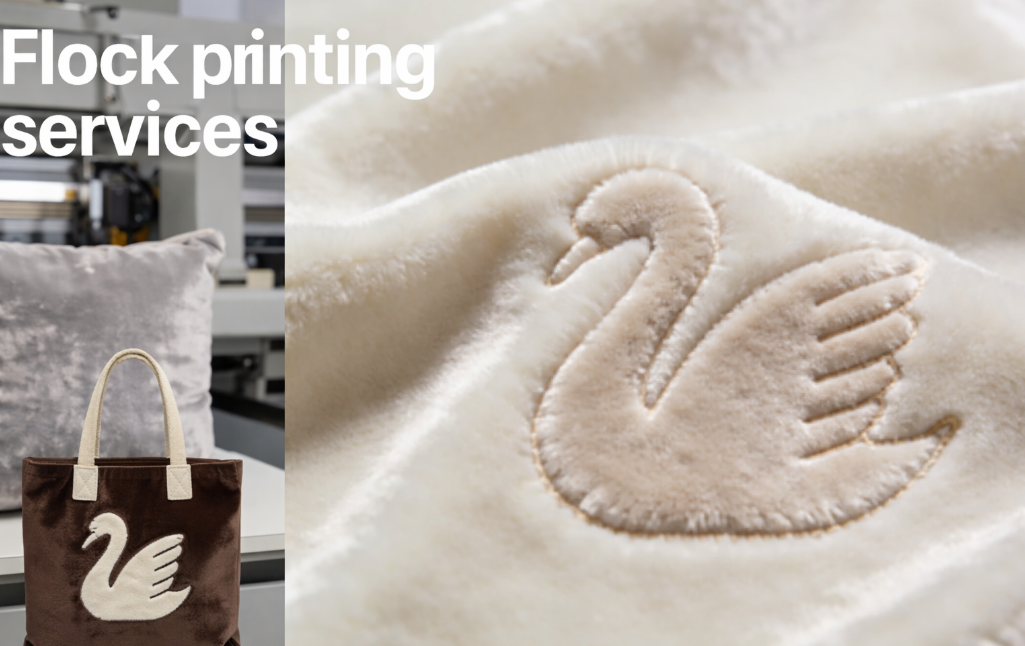
What are Flock Printing Services?
Flock printing services are a textile finishing and printing solution that applies short fibers onto a surface to create a soft, suede/velvet feel. Instead of laying down a flat layer of ink, flock printing builds a three-dimensional texture. The result is a high-end tactile effect often used for branding and decorative patterns.
Typical deliverables from professional flock printing services include:
· Patterned flock areas (logos, lettering, geometric designs)
· Consistent pile density and smooth hand-feel
· Strong bonding for wash and wear performance
· Optional color matching, multi-color designs, or layered effects
Because flock can be applied through different methods, buyers may also see terms like flock printing on fabric, flock transfer, or flock screen printing depending on the production route.
What makes flock printing different from standard printing?
Standard printing methods (like plastisol, water-based ink, sublimation, or digital print) produce mostly flat, ink-based visuals. Flock printing is different in three key ways:
· Texture and thickness: flock creates a raised surface, adding physical depth.
· Premium appearance: it looks richer under light due to fiber reflection and shadowing.
· Touch value: a soft, velvet feel that standard ink rarely matches.
That said, flock printing demands tighter process control. If adhesive thickness, fiber quality, moisture, or electrostatic parameters drift, the surface can become uneven—leading to “bald spots,” rough feel, or weak adhesion.
What is the flocking process?
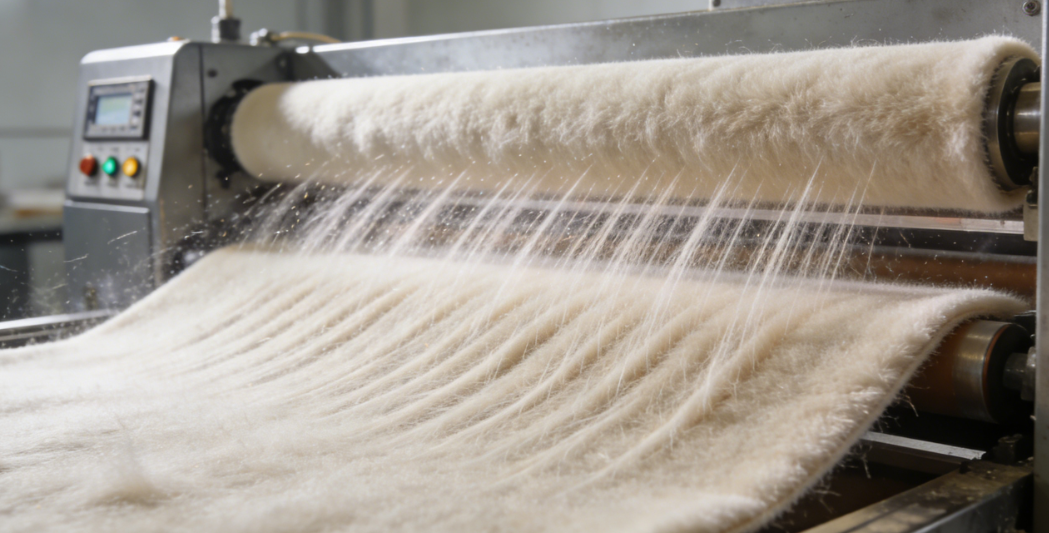
Overview of the complete flock printing workflow (high-level map)
If you are evaluating suppliers, it helps to understand the full production map. What is the flocking process? In most factories, the workflow looks like this:
High-level flock printing workflow:
Substrate prep → Adhesive application → Flocking (electrostatic or manual) → Curing/Drying → Cleaning/Brushing → Inspection → Packing
Key inputs that determine final quality
The final look and durability depend on a small set of “critical inputs,” including:
· Flock fiber length and distribution (uniformity is essential for smooth texture)
· Flock material type (rayon, nylon, polyester—each behaves differently)
· Adhesive system (flexibility, compatibility with fabric, cure behavior)
· Electrostatic flocking settings (voltage stability, grounding, airflow, enclosure design)
· Curing conditions (temperature/time profile to fully lock fibers)
· Moisture and conductivity control (strongly affects electrostatic behavior and deposition)
For buyers, the practical takeaway is simple: the best flock printing services are built on consistent inputs, standardized recipes, and reliable QC—not just attractive samples.
How does electrostatic flocking work?
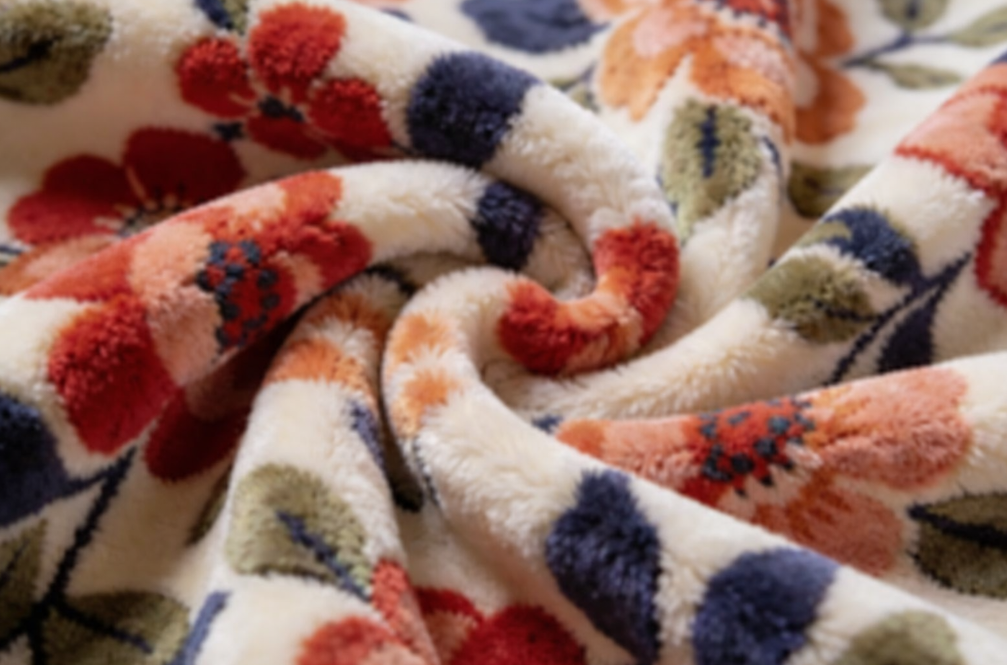
Electrostatic Flocking (core concept)
How does electrostatic flocking work? In electrostatic flocking, flock fibers are electrically charged and propelled toward a grounded substrate coated with adhesive. Because of the electric field, fibers tend to align upright and embed vertically into the adhesive, producing a dense, uniform pile.
This alignment is the main reason electrostatic flocking is the preferred choice for premium apparel and branding applications. It delivers:
· Better texture uniformity
· Cleaner edges on patterns
· Higher perceived quality and smoother touch
· Improved consistency when process conditions are controlled
Electrostatic flocking vs non-electrostatic flocking
Not all flocking uses electrostatic fields. Some low-cost processes rely on gravity or manual application, which tends to create random orientation and less consistent density.
|
Method |
Fiber Orientation |
Texture Uniformity |
Typical Use |
Trade-offs |
|
Electrostatic flocking |
Upright, aligned |
High |
Apparel, premium prints |
Requires controlled equipment |
|
Gravity/manual flocking |
Random |
Medium–Low |
Low-cost decoration |
Less consistent pile |
For most professional flock printing on fabric, electrostatic flocking provides the best balance of quality and repeatability.
China electrostatic flocking machine: what buyers should verify
Many buyers sourcing equipment consider a China electrostatic flocking machine due to availability and competitive pricing. However, flocking quality depends heavily on machine stability and safety design, not just maximum voltage.
Suggested checklist table (machine verification):
|
Buyer Checkpoint |
Why It Matters |
How to Verify |
|
Voltage stability |
Uniform pile density |
Production demo + logging |
|
Grounding design |
Prevents defects + improves alignment |
On-site audit |
|
Dust collection |
Cleaner surface + safer factory |
Filter spec + air test |
|
Control repeatability |
Batch consistency |
Trial runs across shifts |
Even with a strong electrostatic flocking machine, results still depend on fiber condition (moisture, conductivity), adhesive quality, operator discipline, and post-curing control.
Is flock printing durable? (Durability, Wear, Washing)
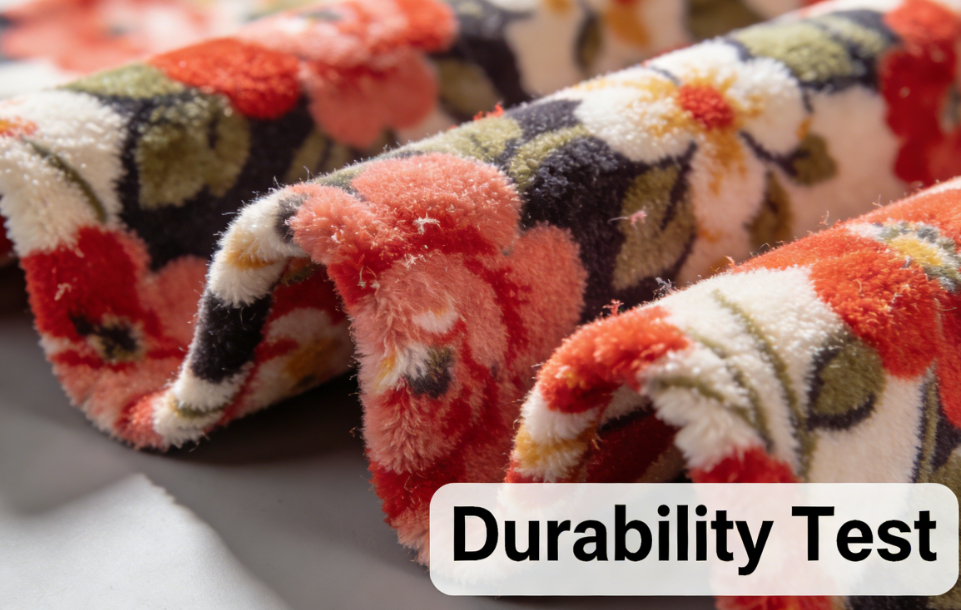
Is flock printing durable?
Is flock printing durable? Yes—when the adhesive system, curing profile, and fiber control are correct, flock printing can be very durable for apparel and textile applications. Many failures that buyers associate with “flock peeling” or “patchy wear” are usually the result of under-curing, poor surface preparation, wrong adhesive selection, or uncontrolled fiber quality.
Durability is not one single property; it’s the combined outcome of:
· Adhesion strength (fiber to adhesive, adhesive to fabric)
· Abrasion resistance (fiber density and surface integrity)
· Wash fastness (bond and color stability through laundering)
· Flex resistance (especially on stretch garments)
Durability factors (what improves lifespan)
If durability is your priority, the most reliable improvements include:
· Choose adhesive matched to fabric (cotton vs polyester vs nylon vs stretch)
· Ensure full curing (time and temperature must meet the adhesive spec)
· Control fiber length distribution (reduces weak spots and rough feel)
· Maintain stable electrostatic conditions (voltage and grounding consistency)
· Remove loose fibers after curing (brushing/vacuum cleaning improves appearance and reduces shedding)
· Define durability targets in writing (wash cycles, rub test, peel threshold)
A professional supplier should be able to recommend a process route based on your fabric and use scenario (daily wash, sportswear sweat exposure, industrial uniform wear, etc.).
Quality Control at Every Step (Based on Real Factory Practice)
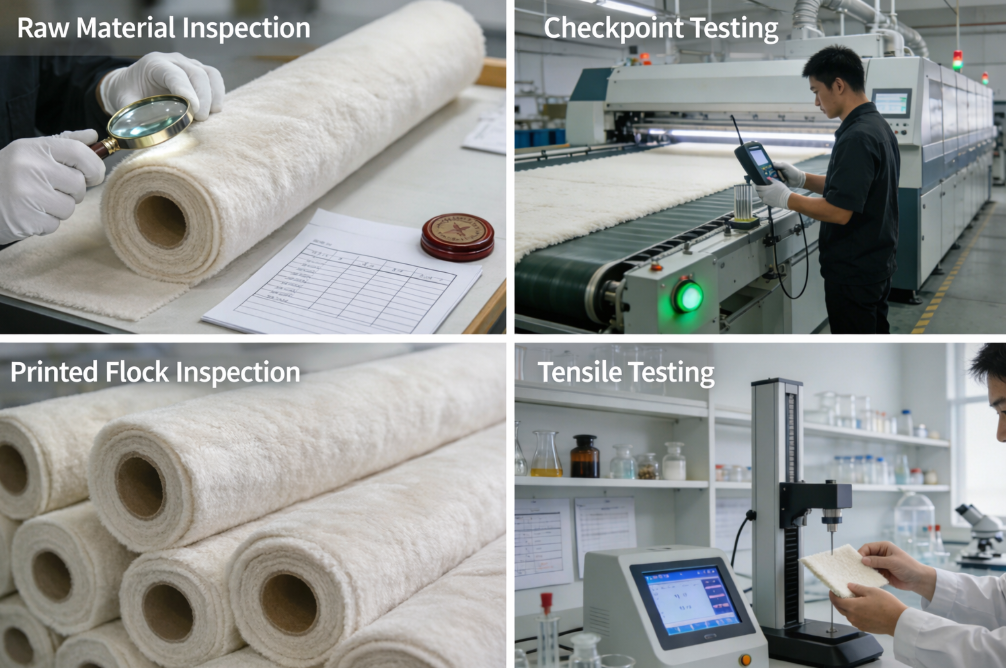
Incoming material standards (fibers, adhesive, base fabric)
High-performing flock printing begins before production. A serious factory sets clear acceptance criteria for incoming materials:
· Moisture control: fibers must be within acceptable moisture range to support stable electrostatic deposition
· Fiber length distribution: consistent length reduces uneven surface and improves edge quality
· Cleanliness: dust and contamination can cause rough texture and weak bonding
· Batch traceability: lot records allow root-cause analysis when complaints occur
These standards are especially important when the factory markets itself as a durable flock powder factory or premium supplier.
In-process QC checkpoints (example workflow)
Real factories control flock quality by monitoring the steps that most strongly influence consistency. A practical QC approach includes:
1) Cutting / length control
· Keep flock length within tolerance (for example, ±0.05 mm if your product spec requires tight control).
· Length stability matters because it affects pile feel, density uniformity, and visual consistency.
2) Grinding frequency / maintenance discipline
· Periodic grinding or process maintenance (for example, checks every 10 minutes in certain operations) reduces drift and improves repeatability.
3) Sampling inspections
· Frequent visual and dimensional checks: camera monitoring plus manual sampling (for example, every 30 minutes) helps detect drift early.
4) Dyeing control
· Follow sample-approved recipes: dosing, temperature, and time must match the standard.
· Color variation is one of the top causes of buyer rejection in flock printing.
5) Drying control
· Monitor moisture and conductivity to keep electrostatic behavior stable.
· Too wet or too dry can reduce fiber alignment and create uneven deposition.
6) Sieving / classification
· Separate by length using multi-stage sieving (often 6–7 passes) and remove non-standard fibers.
· This prevents rough feel and improves surface smoothness.
7) Lab testing per batch
· Test moisture, conductivity, bulk looseness, and “flight time” / dispersion behavior.
· Keep full samples and issue batch reports—this improves traceability and complaint handling.
This kind of structured QC is a major difference between average flock printing and premium, repeatable flock printing services.
Lab test matrix (turn QC into a simple table)
A well-run lab turns quality into measurable data:
|
QC Stage |
What to Measure |
Tool/Method |
Frequency |
Why It Matters |
|
Cutting |
Fiber length |
Gauge/vision |
Per interval |
Uniform texture |
|
Dyeing |
Shade + recipe |
Standard sample match |
Each batch |
Color consistency |
|
Drying |
Moisture + conductivity |
Meter tests |
In-process |
Stable electrostatic behavior |
|
Sieving |
Length distribution |
Multi-stage sieve |
Per batch |
Prevents rough feel |
|
Lab |
“Flight time” / dispersion |
Standard test window |
Each lot |
Predicts flocking uniformity |
For buyers, this table can be used as an RFQ (request for quote) reference: you can ask suppliers which tests they perform and how frequently.
Applications: What Are Flock Printing Used For?
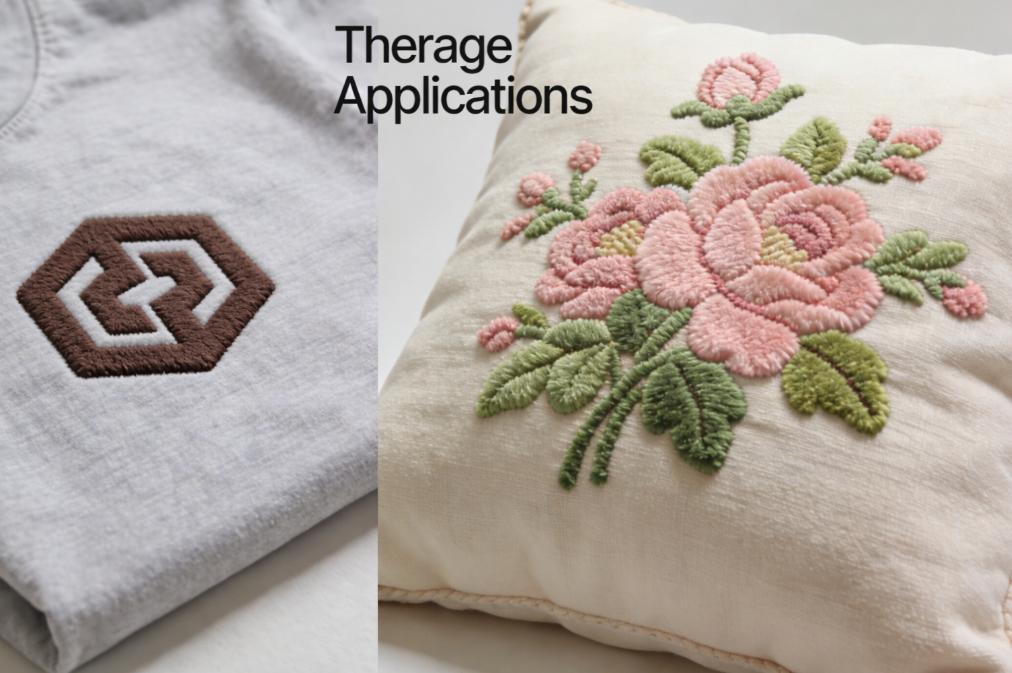
What flock printing is used for (best-fit use cases)
Flock printing is ideal for applications that benefit from texture, premium feel, and brand differentiation:
· Apparel logos and lettering (streetwear, sportswear, fashion)
· Uniform branding and emblems (when durability targets are specified)
· Home textiles (cushions, decorative fabric panels)
· Promotional items and specialty labels
· Packaging inserts and premium decorative surfaces (material-dependent)
Because flock has a tactile value, it is often chosen when the goal is “touch + visual depth,” not just color.
Flock printing on fabric: fabric suitability guide
Different fabrics require different adhesives and process tuning. Here is a practical guide:
|
Fabric Type |
Recommended Adhesive Type |
Notes |
|
Cotton |
Flexible adhesive |
Good bonding, breathable |
|
Polyester |
Higher-adhesion system |
Heat/energy sensitive |
|
Nylon |
Specialty adhesive |
Surface energy challenges |
|
Stretch fabrics |
Elastic adhesive |
Prevent cracking |
For high-detail patterns, many factories use flock screen printing to apply adhesive through a screen, then perform electrostatic flocking so fibers stand upright only where adhesive is present. This method improves edge sharpness and repeatability for logos and small text.
Closing: How to Choose the Right Flock Printing Services
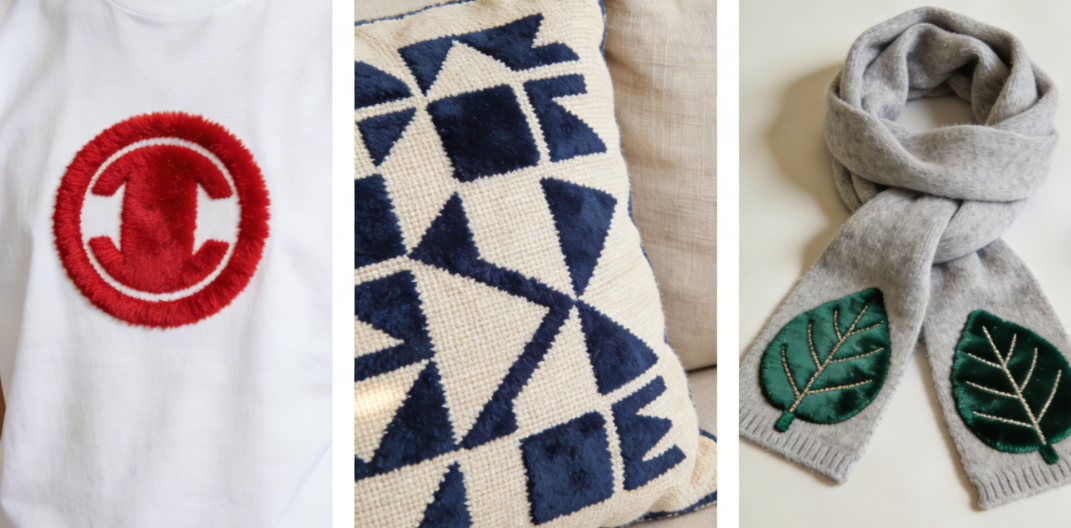
If you want consistent results, select suppliers who can explain their process, show QC records, and match materials to your fabric. The best flock printing services combine:
· Controlled fiber length distribution
· Stable moisture and conductivity management
· Reliable electrostatic flocking machine performance
· Standardized curing profiles
· Batch lab testing and traceability
If you share your fabric type (cotton/polyester/nylon/stretch), target durability (wash cycles), and design details (logo size, coverage), I can help you define a practical process route and an RFQ checklist you can send to suppliers.