Quick Answer
Learn how Automotive Interior Flocking improves EV cabin comfort by reducing noise, glare, and wear on key interior parts for OEM and tier suppliers.
Summary
As EVs become quieter and more design-focused, interior surface performance matters more than ever. This article explains how Automotive Interior Flocking helps OEMs, tier suppliers, and interior component manufacturers reduce cabin noise, glare, and surface wear in high-contact EV interior parts. It also outlines where flocking works best, what buyers should evaluate in materials and adhesives, and how Zhangsflock supports automotive flocking projects with powders, adhesives, equipment, and custom solutions.
Table of Contents
-How Automotive Interior Flocking Helps Reduce Noise, Glare, and Wear in EV Cabins
-Why EV Cabins Need Better Interior Surface Solutions
-What Is Automotive Interior Flocking?
-How Automotive Interior Flocking Improves Performance in EV Interiors
-Where It Is Used in EV Interior Parts
-What Buyers Should Check Before Choosing a Flocking Solution
-How Zhangsflock Supports Automotive Interior Flocking Projects
How Automotive Interior Flocking Helps Reduce Noise, Glare, and Wear in EV Cabins
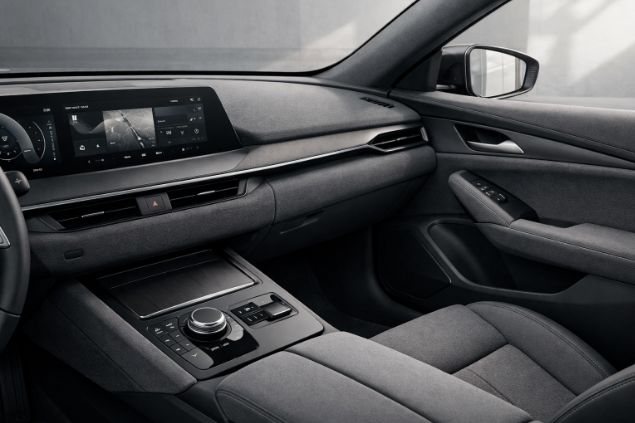
Automotive Interior Flocking is becoming more valuable in EV programs because quieter cabins make small problems more obvious, from rattles and reflections to scratch-prone storage areas.
In internal combustion vehicles, engine and road noise can mask many minor interior issues. In EVs, the reduced powertrain noise makes squeaks, contact noise, and vibration easier for drivers to notice. At the same time, larger screens, panoramic glass, and minimalist dashboards increase sensitivity to reflected light and visible wear. That is why interior surface engineering now plays a more strategic role in perceived quality.
Why it matters: In EV interiors, a small material decision can have an outsized effect on comfort, premium feel, and long-term durability.
Why EV Cabins Need Better Interior Surface Solutions
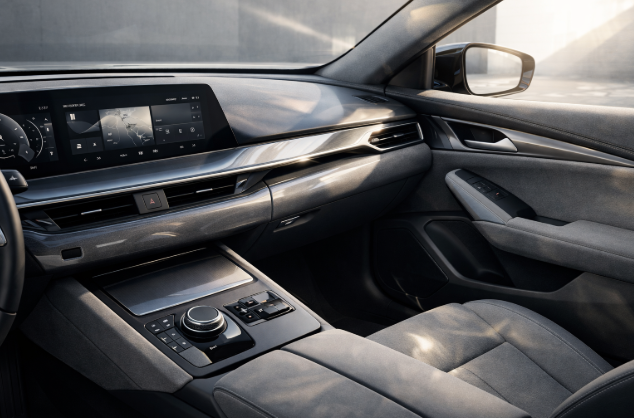
EV cabins need better surface solutions because noise, glare, and wear are more exposed in low-noise, high-visibility interiors.
The shift to electric mobility has changed what occupants notice first. With less engine masking, interior contact points such as door seals, bins, consoles, and glove boxes are more likely to generate objectionable sound. Flocked surfaces can help dampen noise and vibration on these parts, while matte finishes can reduce reflections on dashboards and other visible trim. Zhangsflock specifically highlights soundproofing, vibration damping, anti-glare, and abrasion resistance in automotive interior applications.
For manufacturers, the challenge is not just appearance. It is also about functional performance across repeated use cycles, temperature changes, and sunlight exposure.
What Is Automotive Interior Flocking?
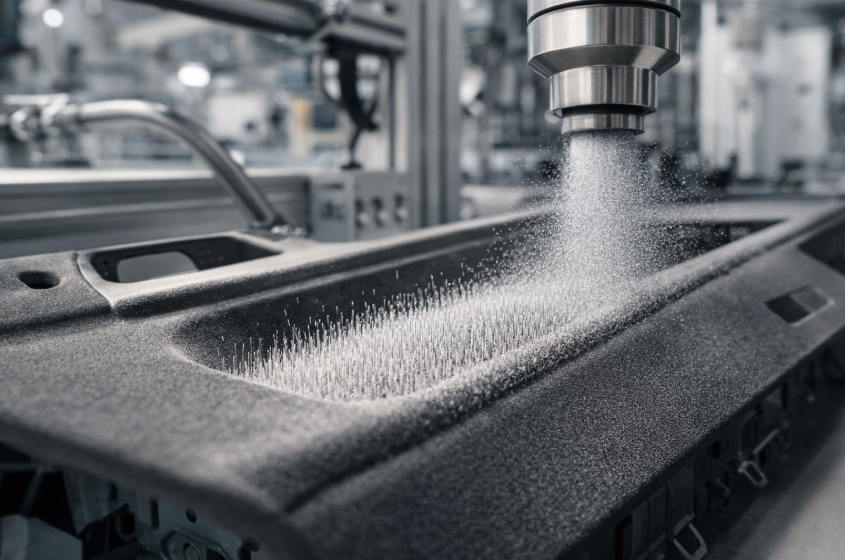
Automotive Interior Flocking is the process of applying short fibers onto a surface coated with adhesive to create a soft, matte, uniform finish.
In most automotive interior flocking applications, the process uses electrostatic flocking. The fibers are electrically charged and projected onto the adhesive-coated substrate so they stand upright and distribute evenly. This creates the velvet-like surface associated with anti-rattle interior solutions and anti-glare interior surfaces. Zhangsflock describes this process as including surface preparation, adhesive application, electrostatic fiber deposition, drying or curing, and quality control.
Typical substrates include:
l ABS and other plastics
l PVC, PP, and PE-based parts
l Rubber and seal components
l Metal or composite technical parts
Zhangsflock states that its flocking adhesive systems can be matched to plastics, steel, wood, glass, leather, foam, and rubber-based materials, which is important for multi-material interior assemblies.
How Automotive Interior Flocking Improves Performance in EV Interiors
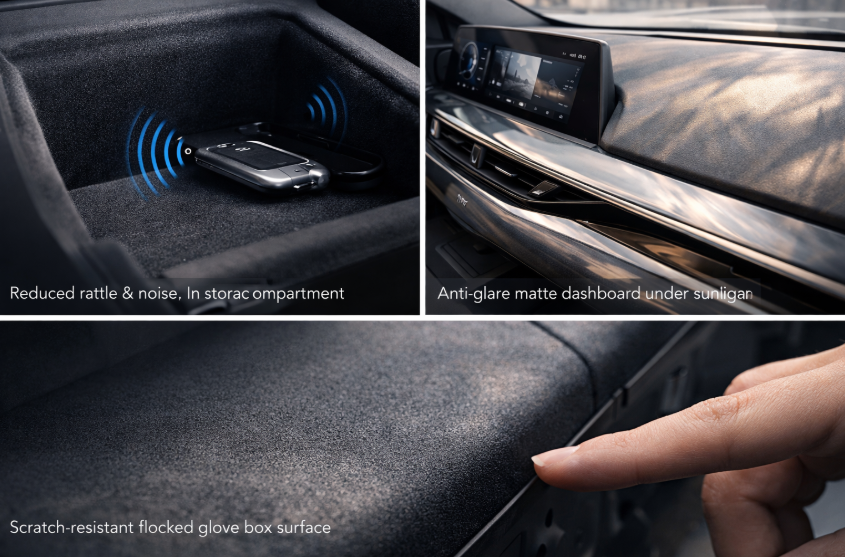
Automotive flocking improves EV interiors by addressing three visible pain points at once: noise, glare, and wear.
Instead of functioning only as a decorative finish, flocking adds performance value where components slide, touch, seal, or reflect light.
EV Interior Issue | Common Cause | Flocking Benefit |
Noise / rattle | Surface-to-surface contact, vibration, movement in seals or bins | Cushions contact points and helps dampen minor vibration noise |
Glare | Light reflection from dashboards or trim | Creates matte, non-reflective, anti-glare interior surfaces |
Wear | Repeated handling, friction, and object abrasion | Adds a protective, wear-resistant layer to high-contact parts |
Noise reduction
Flocked fibers create a soft interface between parts that might otherwise rub or chatter. This is why flocking is often used as part of anti-rattle interior solutions in door seals, storage compartments, and sliding or contacting assemblies. Zhangsflock notes improved noise insulation and vibration damping for interior panels and seals.
Glare control
A flocked finish is typically matte and non-reflective. On dashboards and visible trim, this helps reduce reflected sunlight and screen-related glare, improving both driver comfort and perceived sophistication. Zhangsflock specifically positions flocked dashboards as non-reflective and anti-glare.
Wear resistance
High-contact parts wear out fast when surfaces are hard, glossy, or easily scratched. Flocking adds a soft but protective layer that helps reduce scuffs, scratches, and cosmetic damage in glove boxes, center consoles, and storage trays. This supports more wear-resistant automotive interiors over longer service life.
Key takeaway: Flocking is most effective when it is specified as a functional surface treatment, not just a visual upgrade.
Where It Is Used in EV Interior Parts
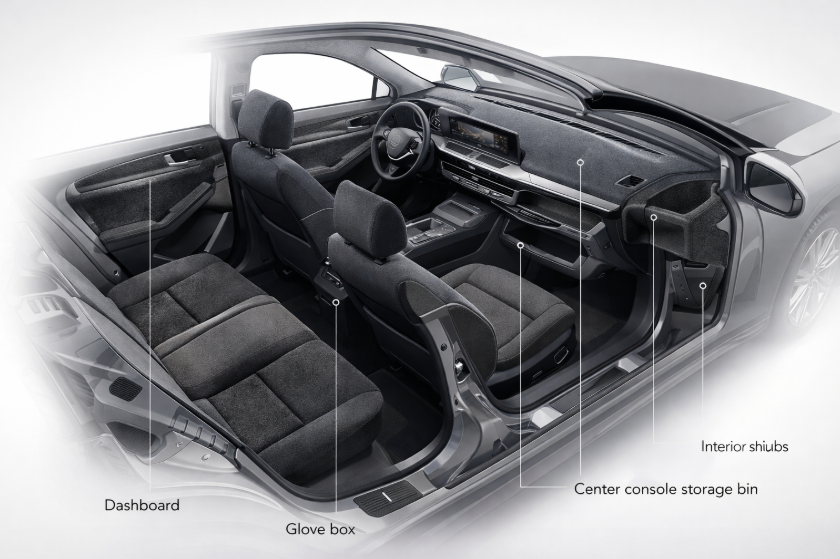
Flocking is used where EV interior parts face repeated contact, visible reflection, or friction-related wear.
Zhangsflock identifies dashboards, glove boxes, center consoles, and door seals as core automotive interior flocking applications, with benefits including reduced glare, scratch resistance, and better noise insulation.
| EV Interior Part | Main Pain Point | Flocking Benefit |
Dashboard | Sun glare and visible reflections | Matte finish improves anti-glare performance |
Glove box | Scratch marks and object noise | Soft, protective lining reduces abrasion and impact noise |
Center console / storage bin | Wear from repeated use | Better surface protection and premium feel |
Door seals | Friction, squeak, vibration | Supports quieter sealing and smoother contact |
Interior panels / contact trim | Minor vibration and scuffing | Added damping and improved durability |
These applications are commercially attractive because they improve perceived cabin quality without requiring major design changes to the full assembly.
What Buyers Should Check Before Choosing a Flocking Solution
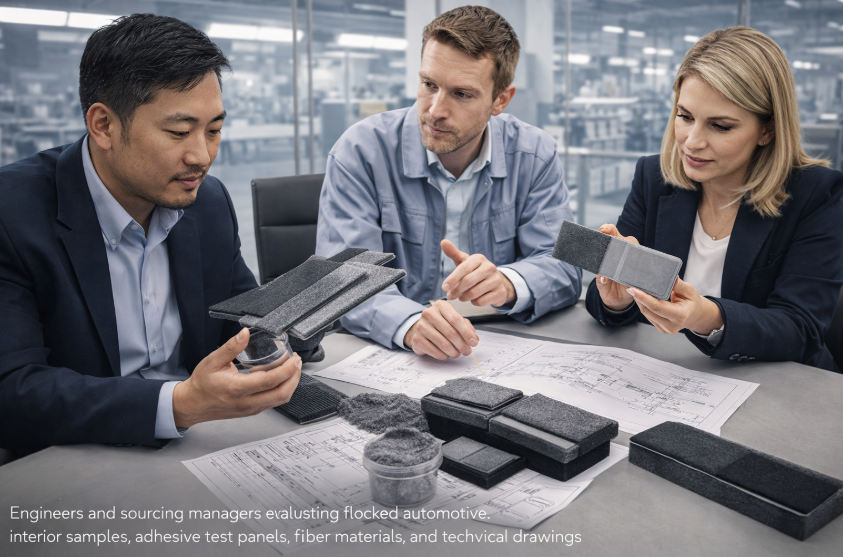
B2B buyers should check material compatibility, adhesive performance, process control, and supplier support before approving a flocking solution.
For OEM, ODM, and tier suppliers, the wrong flocking system can create inconsistency, fallout, poor bonding, or appearance defects. The right supplier should help align fiber type, fiber length, adhesive, substrate, and curing conditions to the application.
A practical buyer checklist includes:
1.Substrate compatibility
Confirm whether the part is ABS, PP, PVC, rubber, metal, or a mixed-material assembly.
2.Flock fiber selection
Fiber type, denier, and length affect touch, wear behavior, and appearance consistency.
3.Automotive flocking adhesive fit
Adhesive must match the substrate, environmental exposure, and production method.
4.Electrostatic flocking consistency
Uniform fiber orientation and surface coverage are essential for OEM-grade appearance.
5.Durability expectations
Ask about abrasion resistance, UV resistance, and long-term bonding performance.
6.Scale and supply reliability
Production support matters as much as material performance in multi-program sourcing.
Why it matters: In B2B automotive sourcing, process stability is often the difference between a premium solution and a warranty risk.
How Zhangsflock Supports Automotive Interior Flocking Projects
 Zhangsflock supports automotive interior flocking projects by supplying the full flocking system, from powders and adhesives to machines and application expertise.
Zhangsflock positions itself as an OEM/ODM flocking solution provider serving automotive, apparel, and industrial uses. Its offering includes flocking powders, flocking adhesives, flocking machines, and car interior accessory solutions. The company also emphasizes industry expertise, custom solutions, electrostatic performance, and annual powder production capacity, which is relevant for buyers looking for both development support and supply continuity.